International Workshop on
ADVANCEs in ICT Infrastructures and Services,
25-28 March 2026, Florianopolis, SC-Brazil
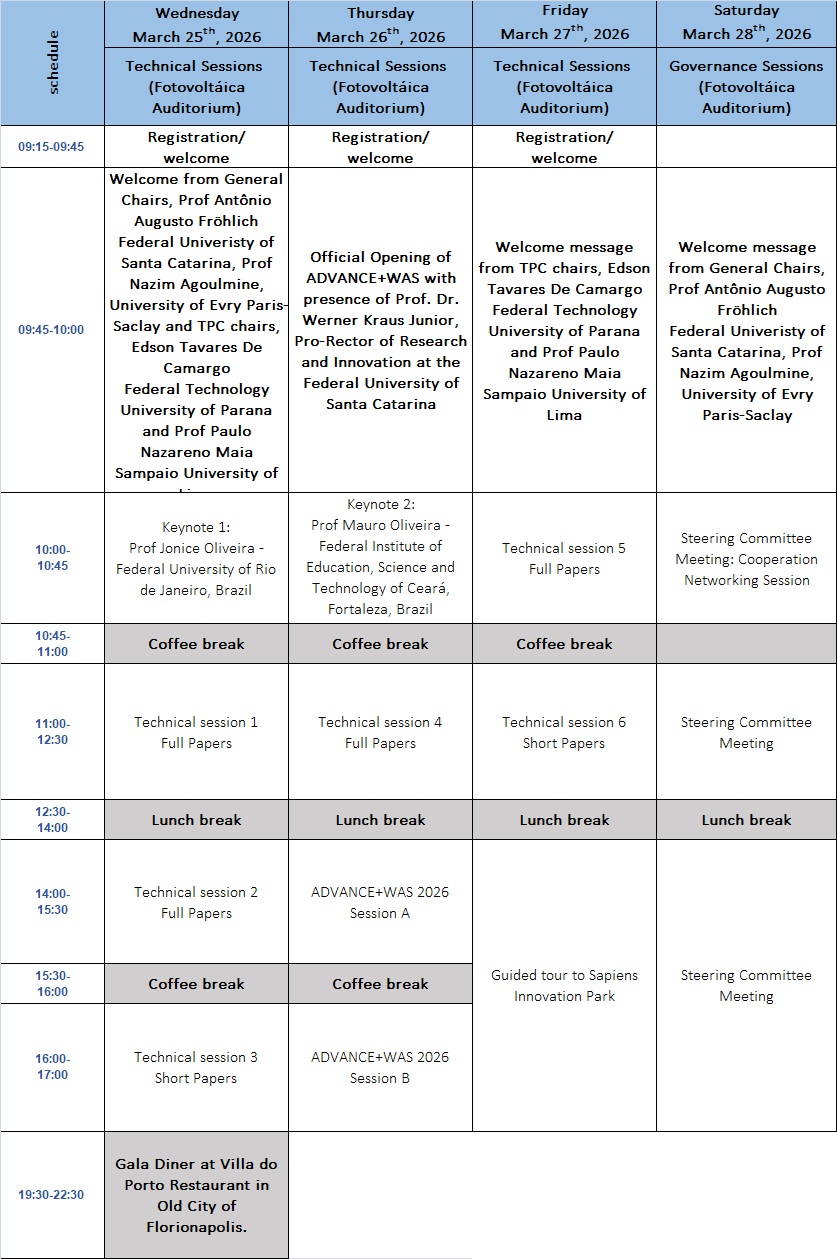
Technical Programme
The ADVANCE Workshop program will be combined with the Workshop on Automotive Systems 2026 organized by the Software/Hardware Integration Lab of the Federal University of Santa Catarina to offer more opportunities for exchange and networking.
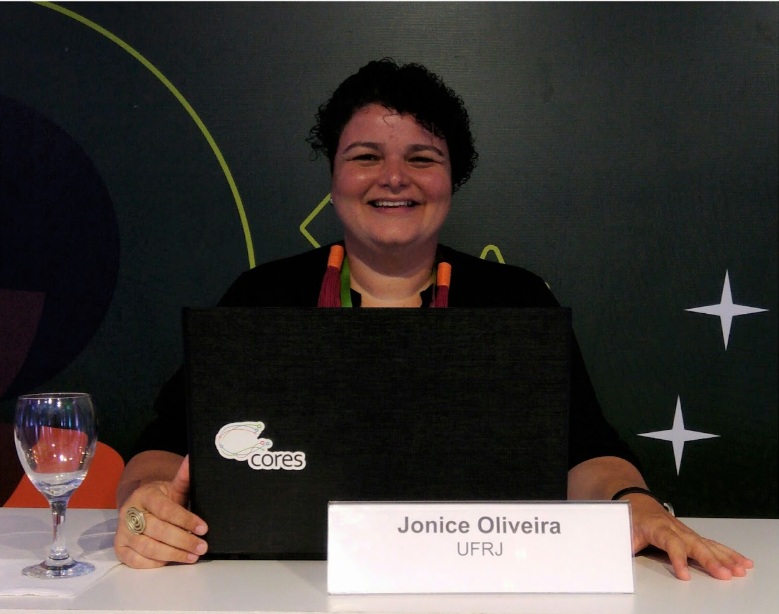
Short Bio: Associate Professor at the Federal University of Rio de Janeiro (UFRJ), she holds a PhD in Systems Engineering and Computer Science, with a multidisciplinary focus on scientific knowledge management at the intersection of management, social computing, and computer science. Her research lies at the interface of data science, social network analysis, and public policy. She is the founder and director of the Social Computing and Network Analysis Lab (Lab CORES), where she leads research on interorganizational network modeling, large-scale data integration, and the analysis of urban and social dynamics.
Technical Session 1 (Full Papers)
Chair: Prof Joberto S. B. Martins
Paper 1.1: An Evaluation of Device-to-Device Communication and URLLC Service in 5G Networks.
Edson Camargo, Antônio Fröhlich
Paper 1.2: Designing Cyberphysical Systems Software Components for Middleware Interoperability
Matheus Wagner, Antônio Augusto Fröhlich
Paper 1.3: Observability: The Missing Piece of Management in NFV-based Network Environments
Guilherme Werneck de Oliveira, Elias Procópio Duarte Jr., Vinicius Fulber-Garcia
Technical Session 2 (Full Papers)
Chair: Prof José Neuman De Souza
Paper 2.1: Towards Automatic Discovery of Correlations between Unstructured and Structured Data in Automotive Data Lakes
Rodrigo Gonçalves, José Luis Conradi Hoffmann, Antônio Augusto Fröhlich, João R. Campos
Paper 2.2: The Impact of Process Competition on Energy Consumption: Analysis and Modeling
Joberto S. B. Martins, Eduardo Gomes Campos, Rafaela Sousa de Alencar Lacerda, Adnei Willian Donatti, Charles C. Miers, Tereza C. M. B. Carvalho
Paper 2.3: PHIOT: A Spatio-Temporal Behaviour Modeling Framework for Phishing Detection in IoT Networks
Swagatika Sahoo, Nathan Cormerais, Abdelhakim Senhaji Hafid
Technical Session 3 (Short Papers)
Chair: Prof Nazim Agoulmine
Paper 3.1: Autonomous Cargo Box Delivery System
Konstantin Aprosin, Robert Reis de Souza
Paper 3.2: ITS@OpenRAN – Towards an Intelligent Transport System support on the Open Radio Access Network
Edson Camargo, Antônio Fröhlich
Paper 3.3: Dynamic Map-based Data-Centric Approach for Tourism and Cultural Heritage Preservation Digital Twins
Joberto S. B. Martins, João Spínola Falcão, João G. P. Hohlenwerger, Daniel C. Santos, Lucas Almeida De Sousa, Nazim Agoulmine
Paper 3.4: Giselle: A RAG-Based Generative AI Platform for Mental Health Care
FABIO JOSE GOMES DE SOUSA, Ronaldo Fernandes Ramos, César Olavo Moura Filho, Luiz Odorico Monteiro de Andrade, Ivana Cristina H. C. Barreto, Antônio Mauro Barbosa de Oliveira
Gala Dinner (included in Full Registration, tickets available at welcome desk)
DAY 2: Thursday March 26th, 2026
Keynote 2 : Prof Mauro Antonio De Oliveira, Federal
Institute of Education, Science and Technology of Ceará,
Fortaleza, Brazil

Title:
"AI Datacenters: Opportunities and Threats"
Short Bio: Prof Mauro Oliveira is a professor at the Federal Institute of Education, Science and Technology of Ceará and in the doctoral program at Oswaldo Cruz Foundation. He holds a Ph.D. in Computer Science from Sorbonne University, an M.Sc. in Electrical Engineering from Pontifical Catholic University of Rio de Janeiro, and a B.Sc. in Electrical Engineering from Federal University of Ceará. He previously served as Brazil’s National Secretary of Telecommunications at the Ministry of Communications and currently represents the scientific community at the Digital Sovereignty Chamber of the Brazilian Internet Steering Committee. His work focuses on digital sovereignty, AI governance, and data center infrastructure.
Technical Session 4 (Full Papers)
Chair: Prof Paulo Antonio Leal Rego
Paper 4.1: Sk-Iterative: A Greedy Scheduling Algorithm with Spatial Reuse for Dense Wireless Networks
Chrystopher Bravos, Fabio Camargo, Flavio Assis, Elias Duarte
Paper 4.2: Bridging Blockchains: A Comprehensive Analysis of Interoperability Challenges and Multi-Blockchain Architectures
Eduardo Albuquerque, Pedro Silva, Matheus Silva, Gislainy Velasco, Sérgio Teixeira, Paulo Cunha
Paper 4.3: SABIÁ: A Guideline for the installation of AI Data Centers as Critical Infrastructure in Brazil
Caio Cavalcanti, Daniel Gularte, Antonio Wendell De Oliveira Rodrigues, Paulo Cunha, Mauro Oliveira
ADVANCE+WAS 2026 Technical Session A
14:00 - 14:30 Computer Vision for Predictive Maintenance of Vehicles
14:30 - 14:50 SmartData on Wheels and ADAS Safety Models
14:50 - 15:10 Vehicular Dynamics in the CARLA Simulator
15:10 - 15:30 On the Modeling the Safety Envelopes of Autonomous Vehicles
16:00 - 16:30 Predicting Transient Overloads Related to ADAS in Time-sensitive Vehicular Networks
16:30 - 16:45 Final Remarks
DAY 3: Friday March 26th, 2026
Technical Session 5 (Full Papers)
Chair: Prof Hakim Abdelhafid
Paper 5.1: Voice of the Streets: a platform for urban violence detection based on social sensing
Eliel Silva, Jonice Oliveira, Tiago França
Paper 5.2: Analysis of ZKPs-based approaches of Multi-party blockchain-based genomic data sharing.
Huyen Trang Le, Adnan Imeri, Nazim Agoulmine
Paper 5.3: GISSA GPT: An Agent-Oriented Architecture for Intelligent Governance in Digital Health
Caio Leandro Rodrigues Cavalcanti, Fabio Gomes De Souza, Rodrigo Matos Aguiar, César Olavo De Moura Filho, Luiz Odorico Monteiro de Andrade, Antônio Mauro Barbosa de Oliveira
Technical Session 6 (Short Papers)
Chair: Prof Nazim Agoulmine
Paper 6.1: Fine‑Grained Personal Data Usage Control using Blockchain, Verifiable Credentials, and IRM Technologies
Louis Raffin, Karima Boudaoud, Yves Roudier
Paper 6.2: Proposal for Automating the Verification of Vulnerability Fixes in Fork-based Projects
Robson S. Santos, Lincoln S. Rocha, Paulo A. L. Rego, Emanuel B. Rodrigues, José Neuman Souza
Paper 6.3: CARAMEL: A Microservice-Based Infrastructure for Scalable Big Social Data Management
Paulo Freitas Silva Júnior, Taigo Cruz de França, Jonice Oliveira
Paper 6.4: Addiction Markers in Online Betting and Casino Platforms: A Systematic Literature Review
Pierre Kouyoumdjian, Karima Boudaoud
DAY 4: Saturday March 27th, 2026
Steering Committee Meeting : International Cooperation Networking Session.
Our Partners
